Calgary, September 30, 2026 – Record Resources reports 3D seismic reprocessing and a resource report on its 20 percent-owned Ngulu oil block in Gabon to be completed by year-end.
As disclosed in Consortium Partner, Reconnaissance Energy Africa Ltd. (September 28, 2026 news release): “The 3D seismic reprocessing program is utilizing the most current state-of-the art reprocessing technology. The reprocessing project is expected to be completed before year end, concurrently a resource report will be commissioned and appraisal well locations to the Loba oil discovery will be selected. Well planning has commenced for an anticipated spud.”
As reported by Reconnaissance Energy Africa Ltd., the 3D seismic reprocessing technology includes DUG’s Full Waveform Inversion (MP-FWI) to help illuminate oil bearing reservoirs within the Loba discovery and the vast salt related exploration inventory mapped by the previous operator on the concession.
Prior to 1995, previous operators would only have been able to utilize 2D seismic for geophysical surveys. While 2D was a vast improvement over gravity and magnetic surveys, it was not nearly as effective at guiding and determining drilling locations as 3D seismic. From this point of view, the Ngulu Block remains relatively unexplored.
The consortium is exploring the Ngulu block, which covers 1,214 Km2 and is equivalent to 54 Gulf of Mexico blocks, is in shallow water offshore central Gabon. This strategic block is located on trend to several sizable producing oil fields. The key aspects of the Ngulu Block include the Loba oil field discovery and over 28 seismically identified prospects in the Pre-salt Gamba / Dentale and Post-salt plays (See figure 1 below).
Figure 1:

Our marquee prospects on the block include Lepidote Deep (Post-salt play), the Palomite Complex including Deep (Pre-salt play) and shallow (Post Salt) prospects and the Pompano complex with both postsalt and subsalt prospects.
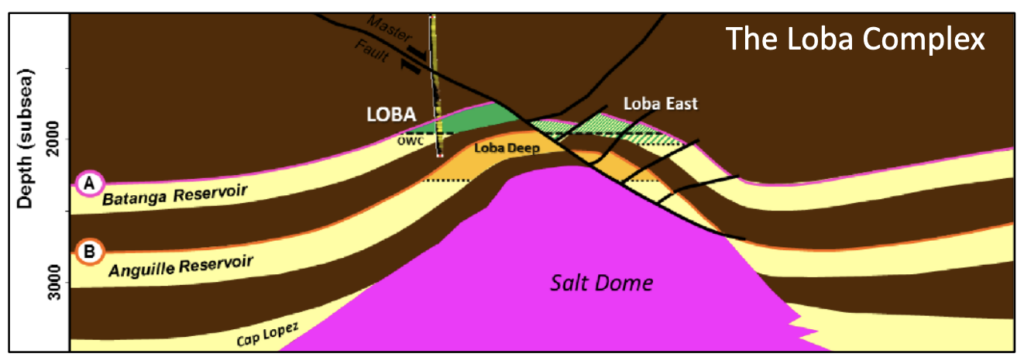
The Loba discovery was made by Elf-Gabon’s LOM-1 well, which targeted the Batanga and Anguille reservoirs. The LOM-1 well discovered a shallow oil zone (27o API gravity oil) in the Batanga Formation with 140 metres of gross oil column (70 metres net pay) and is similar to nearby producing fields Barbier, Barbier Southwest and Ablette.
The Loba oil discovery was made in 60 metres of water depth and is approximately 10 kilometres from the Barbier field existing infrastructure, operated by international oil company Perenco. Management believes that low-cost options are available for the development of the Loba Complex, which include the initial Loba oil discovery and follow-on appraisal targets at Loba Deep and Loba East.
The Loba complex (See figure 2 below), has potential production of ~20,000 Bbl/d (1)(2)(3)(4) based on offset fields. Wells in analogous fields have shown Initial production rates (“IP rates”) up to 7,600 Bbl/d of oil with a single completion (1)(2)(3)(4). These analogous wells are located within 40 km from the Loba Oil Complex and are in the same targeted reservoir.
- Grondin Field. AAPG Memoir Giant Oil and Gas Fields of the Decade: 1968-1978 / Geology of Grondin Field. Peak field production at Grondin ~25,000 bbl/d.
- Baudroie field, Nguma Moabi TCM report 17, May 2006. Initial production 1972. Total production reported at 42,000 bbl/d. IPs up to 7,600 BBls/d.
- Torpille field, operator Societe des Petroles d’Afrique Equatoriale Francaise (Total Energies), 1972 report. Total field production reported as 25,000 BBls/d.
- We are unable confirm if the reports were prepared by a qualified reserves evaluator or auditor or in accordance with the COGE handbook.
Figure 2: